




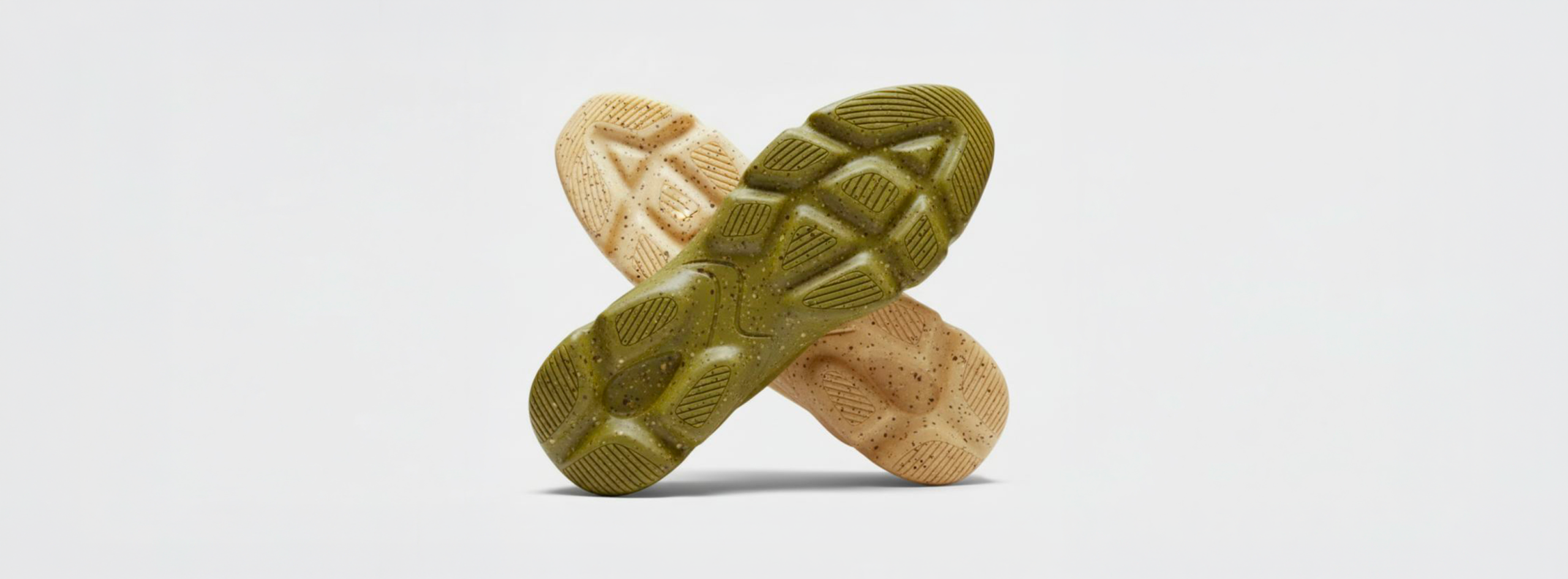

From food waste to the sole
Milan Design Week 2026, Galleria Rossana Orlandi. Among the projects presented at Fuorisalone is The Door, the installation by Patricia Urquiola created using Cimento® technology. The detail worth a closer look is found in the technical data sheet for the materials: some of those decorative panels are made from olive stones, eggshells, sunflower residues and seashells. Agro-industrial waste engineered in a laboratory in Faenza.
That company is called AgroMateriae. It was founded in 2020 after three years of research in the laboratories of the University of Modena and Reggio Emilia. It filed the patent for its process in 2019 and, in December 2020, won the National Innovation Award, joining the Tampieri Financial Group of Faenza in 2022.
In 2023 it launched its pilot plant; today it produces biofillers on an industrial scale — bio-based additives for rubber, plastic and coatings — with a capacity of 3–5 kilotonnes a year. In 2024 it received the Lorenzo Cagnoni Award at Ecomondo.
The figures point to a trajectory the footwear sector should start paying close attention to. AgroMateriae’s biofillers are made up of 96–100% total renewable content under the EN 16848 standard, and 98–100% renewable C14 carbon under EN 16640. They meet the requirements for industrial composting (EN 13432) and soil biodegradability (EN 17033). They are certified by Bureau Veritas in line with the ReMade v. 2.0_2023 protocol and comply with the Minimum Environmental Criteria. Their carbon footprint is currently being certified to ISO 14067, with expected values lower than those of conventional mineral or petrochemical fillers.
The application to footwear is direct. These 100% bio-based ingredients become components for low-impact rubber and plastic soles, integrating into existing production chains without requiring product redesign. A crucial point for Italian districts: the innovation builds on established industrial processes and provides third-party certifications already in place for the regulatory requirements taking shape across Europe — ESPR, the Digital Product Passport, and textile EPR.
There remains a point of friction worth naming. Startups like AgroMateriae offer traceable, measurable ingredients; Italy’s footwear districts bring artisanal know-how and supply-chain capability. Structured dialogue between those who produce biofillers and those who design soles, however, is still occasional. Yet it is precisely at this intersection that part of the sector’s sustainability over the next five years will be decided. A sole made from olive stones and ground eggshells is today a documented, certified and replicable industrial choice.
Next Thursday we’ll take a closer look at the world of second-hand goods. Can a fast-growing trade like the second-hand market be improved — and made profitable?